
What makes up a BioGill unit?Each BioGill treatment unit consists of the following components;
|
BioGill capacity
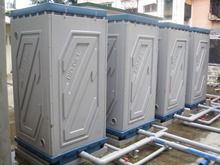
The size of a standard BioGill treatment core for commercial purposes is 1150mmW x 1150mmD x 2420mm H (with lid on). This treatment core can treat up to 20,000 litres of wastewater per day, depending on the influent composition and the level of treatment required.
Our inhouse specialist engineers can work closely with you to size and optimise the system for individual applications.
How BioGills work?
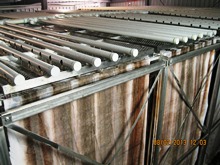
Wastewaters are transferred to the treatment tank. A recirculation pump then pumps this wastewater to the top of the BioGill unit. The waste stream is then spread across the gill sets, via the flow distribution system. The nature of the gill sets allows for immediate dispersion throughout the system. Gravity moves the waste stream down through the gills and back into the treatment tank.
Along the Nano-Ceramic Membranes™, highly active and healthy biomass consumes the nutrients from the waste stream during each pass of the wastewater. The number of passes is proportional to the strength of the wastewater.
A typical treatment cycle for a waste stream involves multiple passes of the liquid through the BioGills. Biochemical Oxygen Demand (BOD) removal during a treatment cycle can be up to 90% per stage depending on the makeup of the waste stream and at an operating temperature of > 20°C.
What do BioGills treat?
BioGills house biomass cultures that effectively reduce carbon, nitrogen, sulphur and organic compounds. In particular, BioGills achieve high performance in the reduction of:
- BOD from high nutrient load waste streams
- FOGs (fats, oils and greases).
- Nitrogen
As BioGills are a liquid treatment system, the recommended particle size is 2mm or less in diameter. Therefore, pre-screening may be necessary on certain influent types to remove solid particles over this size. BioGills are resilient to reasonable amounts of detergents, soaps and cleaning products within the waste stream.
Important note: As with all biological treatment systems the performance of BioGills is retarded by any sanitising components within the influent, such as high concentrates of disinfectant like Quaternary Ammonium compounds, Sulfur Dioxide and Hypochlorite.
In addition, BioGills do not remove salts, minerals and heavy metals. Such compounds however, should not damage the treatment cores.
Small amounts of petro-carbons, oils and grease can be effectively removed. Research is now underway to significantly improve the removal rate of petro-carbons from waste streams using BioGill technology.
Operating environments
The ideal operating range for a BioGill system is between 15 - 37°C. Below 15°C the system begins to “slow-down”. The temperature within the BioGill unit will depend on both the ambient and influent temperature.
To maintain a warm, constant temperature for the biomass, the treatment chamber may need to be insulated, depending on the local conditions.The internal temperature is somewhat self-regulated and depends on the nature of the influent.
Key system design features
1. Sludge removal
Sludge is produced from the formation of new biomass, dead biomass and inert material in the waste stream. A BioGill system is capable of running very high sludge age due to the natural makeup of the biofilm biomass.
Unlike conventional wastewater treatment where MLSS at around 4500 mg/l is expected and MBR plants where the MLSS can be pushed slightly higher to 8,000 - 10,000 mg/l, biofilm biomass can accommodate as high as 50,000 mg/l. The high sludge age reduces the biomass yield due to a larger component of the biomass operating under "Endoegnous Respiration" conditions.
The BioGill system may cannibalise a large percentage of its own sludge. Any sludge that remains at the completion of a batch cycle can be easily removed by incorporating a sludge pump.
2. Flow rate
The flow rate of the pump to recirculate the wastewater through the gill sets is determined by:
- the treatment volume
- divided by the treatment cycle time
- multiplied by the predetermined treatment index.Settling stage
3. Settling Stage
Settling is an important stage of the BioGill treatment cycle. At the end of the pumping recirculation stage, high levels of oxygen and low levels of nitrogen are contained within the treatment tank. The high level of oxygen ensures higher level microorganisms like Protozoa flourish and "roam" around the tank, consuming lose lower level organisms. This has the effect of lower SS in the treated effluent and reduces turbidity.
Settling of suspended solids is achieved during this period. Following this stage, treated wastewater can be transferred for disposal or reuse.
4. Treatment cycle time
Treatment time depends on the waste production cycle, the nutrient loading of the waste stream, the Nano-Ceramic Membrane™ area in use and the discharge requirements. In standard systems a treatment cycle is generally run over 24 hours. This can be significantly increased or reduced as required by the project’s specifications.
5. Control and monitoring systems
The control and monitoring of each BioGill system depends on plant load and the required level of treatment. It may be as simple as a basic timer and float switch, through to a Programmable Logic Controller (PLC). Touch screen capability can be incorporated into a PLC with alarms sent as SMS messages to mobile/cell phones or via the internet. (PLCs supplied separately).
6. Disinfection system
If the discharge is to be reused and therefore involve human contact, the water will need to be passed through a disinfection stage. As BioGills are so effective at removing BOD and suspended solids, the disinfection stage is highly efficient and usually involves hypochlorite dosing or UV sterilisation.
How do you start a BioGill system?
BioGill systems are self-optimising in that the microorganisms most suited to metabolising the waste steam become dominant within the BioGill treatment core. In many instances these naturally occurring microorganisms are within the waste stream.