
Welcome to our Frequently Asked Questions page. Please click on a question below.
Biomass
A large part of the biomass is fungal and not affected by antibiotics. In addition, because the bacteria in the system is only a component of the biofilm it actually uses its “neighbours” immunity to the antibiotic. The biomass acts as a symbiotic relationship.
For a quick start up, systems can be seeded with inoculates. If the gills are inoculated initially they will quickly ramp up and should be treating the waste stream within 24 hours. Without inoculation this process should take around 3 days.
Capacity
Treatment time depends on the waste production cycle, the nutrient loading of the waste stream, the Nano-Ceramic membrane area in use and the discharge requirements. In standard systems a treatment cycle is generally run over 24 hours. This can be significantly increased or reduced as required by the project’s specifications.
Each BioGill core has a varying volume capacity depending on the quality of influent to be treated. For example, grey water treatment can be as high as 20,000 litres per day, while sewage is around 14,000 litres per day. Some extreme influents as found in industrial waste may be around 5,000 litres per day.
1150mm x 1150mm x 2300mm high
As a guide, on a 50,000 litre system the required flow rate is around 8 litres a second.
Maintenance and Warranty
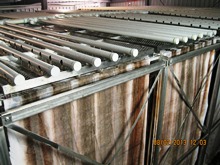
The membranes are self-optimizing in that older biomass will slough off the gills and be automatically replaced by healthy new biomass every few days.
BioGill provides a full 5 year warranty on the Nano-Ceramic Membranes™ and a 12 month warranty on all components of the system including stainless steel frames. Pumps, controllers and tanks usually carry a manufacturer’s warranty.
Maintenance on the BioGill core is extremely low. We do however, recommend 6 monthly checks on the overall system. A service includes checking all the pumps and control systems, checking for fouling within the plumbing and dispersers and testing of both influent and discharge to ensure the system is meeting the operational requirements.
Temperature
Between 15 - 37 degrees Celsius.
Retrofitting
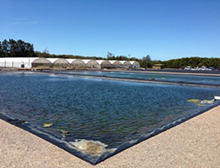
Yes. By installing BioGill cores over the existing tank or pond and circulating the wastewater to the top of the gills, water quality will dramatically improve. BioGills not only remove nutrients from the waste stream they also add oxygen naturally during the treatment process. This helps to create healthy water.
Sewage
As composting toilets do not work with flushing water, the leachate is much more concentrated than septic systems. The high BOD and Nitrogen concentration makes it a particularly nasty problem as it pollutes and smells once absorbed into the ground.
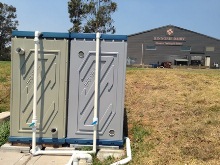
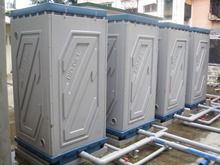
BioGills tend to perform extremely well with this concentrated mix and offer a great way to deliver effective sanitation to remote and third world sites, with low water use small tanks and low energy use.
Sludge
The BioGill system can be configured to largely cannibalise its own sludge with any accumulated sludge recirculated back through the gills. Any sludge that remains at the completion of a 24 hour batch cycle can be easily removed by incorporating a sludge pump that works off a timer for automatic removal.
Sludge removal should be done every 4-28 days depending on the application. In some cases sludge removal would be possible only once every year or two in the case of pre-treatment of industrial wastewaters for sewer discharge. Sludge cannibalisation can be optimised by transferring the sludge to a holding tank on the Monday and returning the decant to the aerobic system on the Sunday (quiet day) to digest the soluble nutrients released during autolysis during the week.